Nobody asked the software companies
Canada's payments infrastructure changed owners three times in thirty months. The platforms sitting on top of it had no say and no upside.

Canada's payments infrastructure changed owners three times in thirty months. The platforms sitting on top of it had no say and no upside.
On August 11, RBC and BMO agreed to sell Moneris to Francisco Partners for roughly C$2 billion in cash.
Moneris is not a small piece of Canadian commerce. About 325,000 points of commerce, close to one in three Canadian card transactions, more than five billion transactions a year. Two of the country's largest banks built it, ran it for twenty-six years, and have now sold it to a private equity firm in San Francisco.
The commentary showed up fast and mostly went one direction. Data sovereignty. Whether Canadians' purchase records should sit under US jurisdiction. Whether a PE owner raises prices. All fair questions.
But there's a group with real exposure to this deal that almost nobody wrote about. It's the group we spend all day with: Canadian software companies.
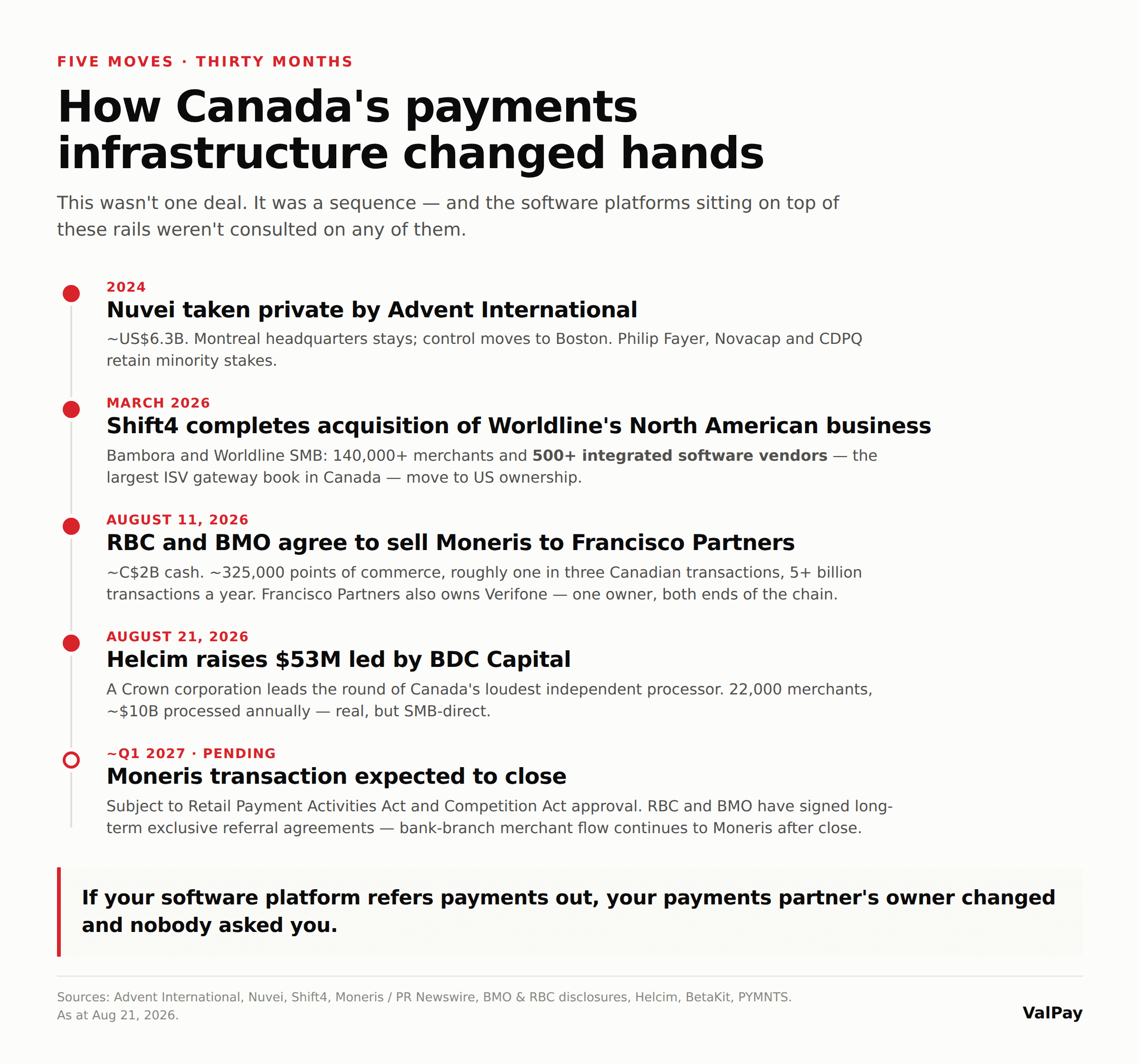
This wasn't one deal
The Moneris sale reads very differently as the third event in a sequence than it does on its own.
2024. Nuvei, Montreal-founded and TSX-listed, the closest thing Canada had to a homegrown global processor, is taken private by Advent International for about US$6.3 billion. The head office stays in Montreal. Philip Fayer, Novacap and CDPQ keep minority stakes. Control moves to Boston.
March 2026. Shift4 completes its acquisition of Worldline's North American business. That includes Bambora, and with it more than 140,000 merchants and 500-plus integrated software vendors, plausibly the largest ISV gateway book in the country. Five hundred software companies changed payment partners as a line item in somebody else's transaction.
August 2026. Moneris.
Each of those was defensible on its own terms. Put together, they describe something specific. The layer of infrastructure Canadian software platforms depend on to monetize payments moved into foreign ownership over roughly thirty months, and the platforms were not party to any of it.
Who's actually left
We wanted to see what the map looked like after all that, so we built it. Every processor and embedded-payments platform of scale serving Canadian merchants, sorted by where the owner sits rather than where the office is.
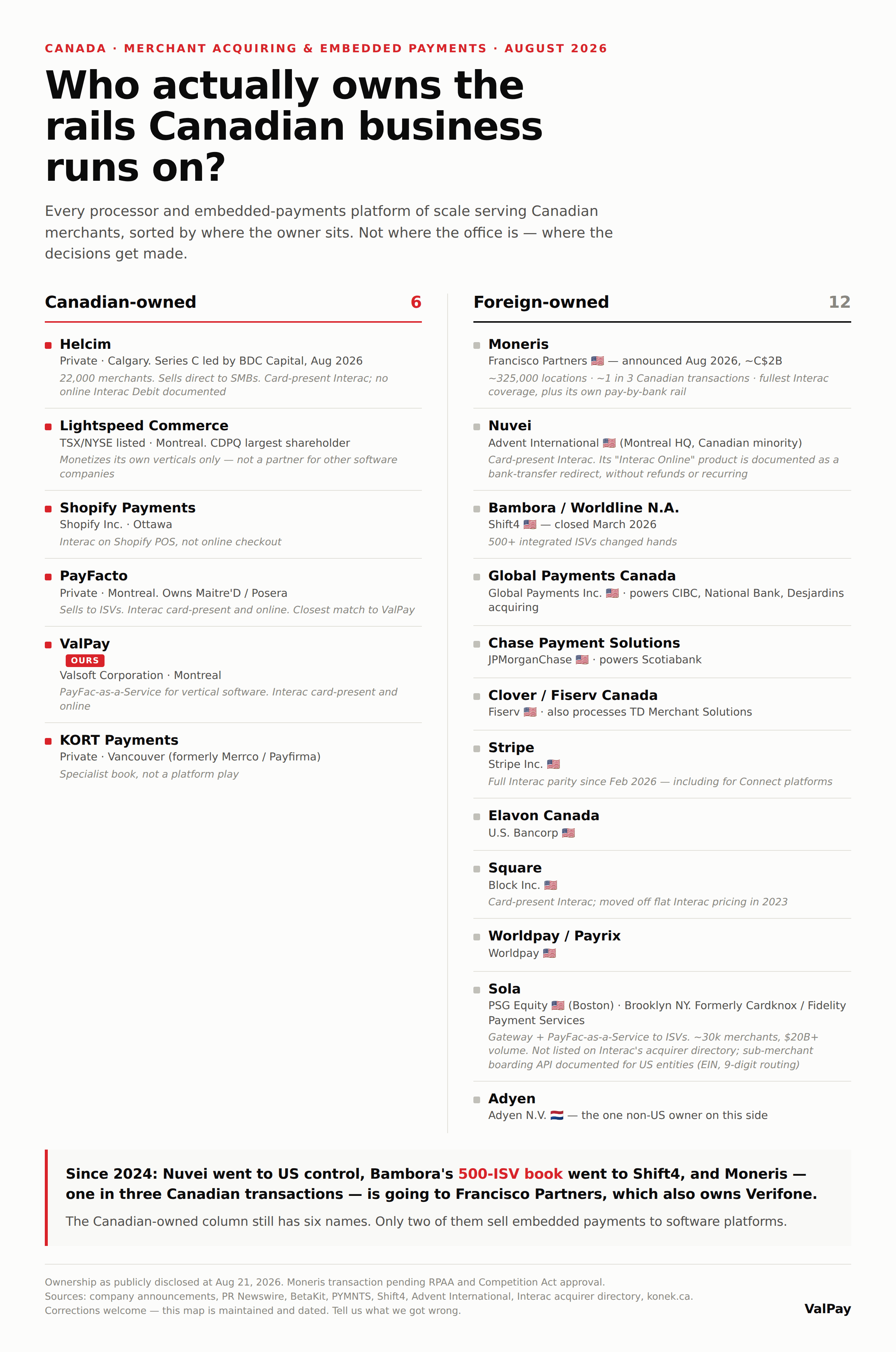
Six Canadian-owned. Twelve foreign-owned. We put ourselves on it, which is the only honest way to publish a map you appear in. Read the rest knowing that.
The count flatters the Canadian column, because most of those six can't be an embedded-payments partner to a software company at all:
Helcim is Canadian-owned, just raised $53 million led by BDC Capital, and serves 22,000 merchants. It sells direct to small businesses rather than through software platforms, and we could not find online Interac Debit documented.
Lightspeed is Canadian, listed, and serious about payments. It monetizes its own verticals. Not a general-purpose partner for other software companies.
Shopify Payments is owned by a Canadian company. Its Interac support is on Shopify POS rather than online checkout.
KORT is Canadian, private, and focused on a specialist book.
Narrow it to what a vertical SaaS company actually needs, which is a payment facilitator relationship that lets you own the merchant and the economics, and the Canadian-owned list comes down to two names. One is us. The other is PayFacto, also Montreal, also Canadian-owned, also selling to ISVs, also supporting Interac Debit card-present and online. If you're running this evaluation, talk to both of us.
That's the market as of August 2026 as accurately as we can describe it, and we'd like to be corrected if we've got it wrong.
One more piece of precision, against our own interest. Interac support doesn't differentiate anyone any more. Card-present Interac runs on fifteen-plus providers including Stripe, on every Canadian reader. Online Interac Debit is a shorter list, but Stripe added it in February 2026 and it reaches Connect platforms, which covers a very large share of Canadian vertical software. The volume is also smaller than people assume: Interac's own figures put online Interac Debit at 14 million transactions in FY2025, against 7 billion Interac Debit transactions overall. Ask about Interac so nothing is missing from your shortlist. Don't pick a partner on it.
What the deal did and didn't promise
The actual language is more careful than the headlines.
Moneris committed to "nearly 2,000 team members across the country, a head office and technology infrastructure fully resident in Canada." Francisco Partners said it would invest while "preserving the deeply Canadian identity." Both are real commitments and we'd take them at face value.
Now notice what isn't in there. Nothing on pricing. Nothing on headcount. Nothing on data residency, where the word used is "infrastructure." And the incoming chairman is Jeff Sloan, formerly CEO of Global Payments, which is not the résumé of a man hired to leave a payments business alone.
One detail matters more than it looks. As part of the transaction, RBC and BMO signed exclusive, long-term customer referral agreements with Moneris. Branch merchant flow keeps going to Moneris after close. Anyone expecting this deal to shake merchants loose at the branch will be waiting a while. The place the market genuinely reopens is the layer above, where software platforms put payments in front of merchants every day.
The part that should bother software founders more
The ownership question gets the attention. This one costs more money.
If you run a vertical software platform in Canada, whether that's a dental practice management system, a hotel PMS, a shop management tool for garages, a tee sheet, a ticketing system or a field service app, your customers take card payments every single day. Every one of them. That's not a feature they've asked for. That's how their business runs.
And in most cases the money moves through a processor you don't own, on pricing you didn't set, paying you a referral fee somewhere between 5 and 15 basis points. You built the integration. You trained the merchant. You take the call when a batch doesn't settle. You get paid like you made an introduction.

Same volume, same merchants, same software, under a managed payment facilitator model: somewhere between 40 and 90 basis points. On $10 million a month that's roughly $10,000 against roughly $70,000. Platforms that treat payments as a product rather than an integration eventually see it become 60 to 70 percent of total revenue.
Full payment facilitator registration used to be what stopped everyone, historically a million dollars and change plus twelve to twenty-four months. PayFac-as-a-Service removed that. The capital and the compliance burden sit with a licensed partner while the platform keeps the brand, the pricing control and the margin.
So the question worth asking this month isn't only who owns your processor. It's why you're running a payments operation for free, and who you want running it with you.
Four things worth doing
Regardless of who you end up working with.
1. Find out who owns your payments partner, and who owns them
Two levels up. Twenty minutes of work, and a surprising number of platforms don't know the answer.
2. Multiply your merchant base's annual processing volume by 60 basis points
If that number is material against your ARR, this is a strategic decision rather than a vendor decision.
3. Read your agreement for the three clauses that matter
Who owns the merchant contract, whether your residuals survive termination, and what happens on a change of control. The last thirty months should make that third one feel considerably less theoretical.
4. Ask any prospective partner the Canadian questions specifically
CAD settlement. Then Interac, and be precise, because "we support Interac online" means four different things in this country right now. Is it Interac Debit tokenized in Apple Pay and Google Pay? Interac e-Transfer with a hosted redirect? Interac Direct through KONEK? Only one of those is Interac Debit. After that: what it costs in store versus online, where data lives, whether support is bilingual and what hours, and whether there's a Canadian legal entity or a reseller relationship. Ask us the same questions. If a partner gets vague about which Interac they mean, you have your answer.
Where we sit
We're not a neutral party and shouldn't pretend to be.
ValPay is a payment facilitator for software platforms. Our parent company, Valsoft, is headquartered in Montreal. We built this by monetizing payments inside our own portfolio of vertical software companies before offering it to anyone else, which meant the model got tested first on operators who could complain loudly and internally.
We're Canadian-owned and we think it matters, because ownership is where decisions about pricing and roadmap and support actually get made. We support Interac Debit card-present and online, which as we said above is table stakes rather than a reason to choose us. And we're not the only Canadian-owned option for software platforms. PayFacto is the other one, also in Montreal, and worth your time.
For what it's worth, we'd put ownership second on the list of things that should decide this. First is whether the economics are real and whether the thing works at the front desk on a Saturday.
The Moneris transaction is expected to close around the first quarter of 2027, subject to Retail Payment Activities Act and Competition Act approval. Between now and then, every Canadian software platform with a merchant base gets to decide what payments is going to be for them.
Worth using the time.
Blake Rouse is Growth Lead, North America at ValPay.
Think we've got the ownership map wrong? Send me a note at blake.rouse@valpay.com and we'll correct it and say we did.
Sources
Moneris, "Moneris announces acquisition by Francisco Partners," PR Newswire, August 10, 2026
BMO and RBC transaction disclosures, August 2026
PYMNTS, "Francisco Partners agrees to buy Moneris from BMO and RBC," August 2026
BetaKit, "RBC and BMO to sell off Canadian payment giant Moneris in $2-billion deal"
Shift4, "Shift4 completes previously announced acquisition of Worldline's North American subsidiaries," March 2, 2026
Advent International and Nuvei, going-private transaction announcements and completion, 2024
Helcim, "Helcim raises Series C," August 2026
Interac, Corporate Year in Review FY2025, and the Interac and Stripe announcement, February 10, 2026
The Canadian Press and Yahoo Finance, "Where the Moneris sale is sparking concerns"
CBC News, Global News, The Logic and The Globe and Mail coverage, August 2026
ValPay, Payment Monetization Playbook
Want to go deeper on this topic?
Talk to our team about embedded payments for your platform.